Carpet Cleaner vs Steam Cleaner: What Is the Difference? (October 2026)
For carpet cleaner vs steam cleaner, choose washing and extraction for dirty carpet or heated vapor for surfaces approved for steam. A carpet cleaner removes dirty liquid, while a steam feature alone does not provide that same cleaning process.
On this page (9 sections)
- Carpet cleaner vs steam cleaner: how do they work?
- Which machine is better for carpet?
- Which cleaner suits upholstery, stairs and hard surfaces?
- Which of these 3 cleaners fits your home?
- What should you check before buying?
- How should you set up and use a cleaner?
- How do you clean and store the machine afterward?
- Which mistakes waste the most effort?
- Carpet cleaner vs steam cleaner: which should you buy?
A carpet cleaner washes and extracts dirty liquid, while a steam cleaner applies heated vapor to surfaces approved for heat. In the carpet cleaner vs steam cleaner decision, start with what you need to remove and where you need to clean.
For dirty carpet, extraction is usually the right starting point. For suitable tile, grout or other heat-safe surfaces, steam may help loosen residue before you collect it.
Some machines combine both methods. That gives you more options, but it does not make every mode safe for every material.

Carpet cleaner vs steam cleaner: how do they work?
A carpet cleaner uses water, cleaning solution and suction to remove soil; a steam cleaner uses heated vapor to loosen dirt or residue. The main difference is how the dirt leaves the surface.
A carpet washer spreads a cleaning mix through the fibers, often with brush action. Suction then draws dirty liquid into a recovery tank, although some moisture remains in the carpet.
A steam cleaner releases vapor through a nozzle or attachment. Depending on its design, you collect the loosened dirt with a cloth, pad or suction tool.
This distinction matters with spills. Loosening a sticky mark helps, but a wet carpet stain also needs a way to remove the dirty liquid.
Does a carpet cleaner vs steam cleaner comparison include hybrids?
Hybrid cleaners belong in the comparison because they combine washing or extraction with a steam function. Their modes still serve different jobs, so choose the process rather than relying on the machine’s name.
The 3 products below are carpet-cleaning options, including 2 with steam features. They are not a comparison between a dedicated steam-only machine and a carpet washer.
For more on the basic machine formats, see our guide to choosing a carpet cleaner machine.
Which machine is better for carpet?
Choose a carpet cleaner with extraction for washable carpet with dirty traffic lanes, spills or soil worked into the pile. A steam-only tool is not a direct substitute for washing and recovering dirty water.
An upright makes sense when you need to cover an open room. Its floor-cleaning format lets you work in lanes instead of moving a small hand tool across every patch.
A portable suits a drink spill beside the couch or a dirty stair tread. Using one for an entire room means more bending, repeated tool strokes and frequent pauses.
Skip wet cleaning until you know the carpet’s care requirements. Fibers, dyes, backing and adhesives can all affect which methods are suitable.
When should you avoid steam on carpet?
Avoid steam when the carpet care instructions rule out heat or the machine is not approved for that carpet. Wool, delicate rugs and specialty constructions deserve particular care rather than a guess based on appearance.
If the carpet type is unknown, ask its manufacturer or a qualified cleaner about the right method. Approval for one rug does not establish that another rug in the same room can handle steam.
Also check what a carpet attachment actually does. Refreshing the pile and extracting embedded soil are different tasks, even if both leave the carpet looking neater.
What works better for pet accidents?
For pet accidents, start with blotting and a suitable stain formula, then use extraction when the carpet allows it. Remove solids carefully before bringing a machine over the area.
Avoid heat on untreated urine stains because it can set the stain and odor. Follow any enzyme formula’s contact time rather than washing it away as soon as you apply it.
Repeated soaking is not a useful response to a returning smell. Urine can reach the backing or material below the carpet, where a surface clean may not resolve the source.
Our guide to cleaning pet urine from carpet with a machine explains how to keep the work focused on the affected area.
Which cleaner suits upholstery, stairs and hard surfaces?
Choose a portable extraction cleaner for approved fabric spots and a steam machine with the right attachment for heat-safe hard surfaces. A tool that fits the space still needs to match the material.
For upholstery, check the care code before adding water. W generally allows water-based care, S calls for solvent-based care, WS allows either, and X means vacuuming or brushing rather than wet cleaning.
A W code alone does not approve steam. Heat limits, cushion filling and the furniture maker’s directions still matter, especially where moisture could soak beneath the cover.
For a couch, clean only as deeply as the care guidance allows. Our guide to using a carpet cleaner on a couch covers that decision before you fill a tank.
On stairs, put the machine on a stable surface and work within comfortable hose reach. Stop and reposition it rather than pulling it toward an edge.
For tile and grout, confirm that both the surface and any sealant allow steam. Do not extend tile-cleaning advice to wood, laminate or other moisture-sensitive flooring.
The portable spot cleaner guide explains when a small fabric-cleaning tool makes more sense than an upright.
Which of these 3 cleaners fits your home?
Pick the upright for room coverage, the HydroSteam portable for varied spot jobs, or the Mini for small spills. Their scores stay tied to each product across GladSwap, so match the format to your home before comparing numbers.
| Product | Best for | Type | Clean tank | Steam feature | Our score |
|---|---|---|---|---|---|
| Bissell Revolution HydroSteam | carpeted family rooms | Upright deep cleaner | 1 gallon | Steam Pretreat and SteamWash Max modes | 7.6 |
| Bissell Little Green HydroSteam | mixed surface spot jobs | Portable carpet and upholstery cleaner | 64 oz. | 8.0 | |
| Bissell Little Green Mini | occasional small spills | Portable carpet and upholstery cleaner | 9.3 |
Bissell Revolution HydroSteam: for broad carpet areas
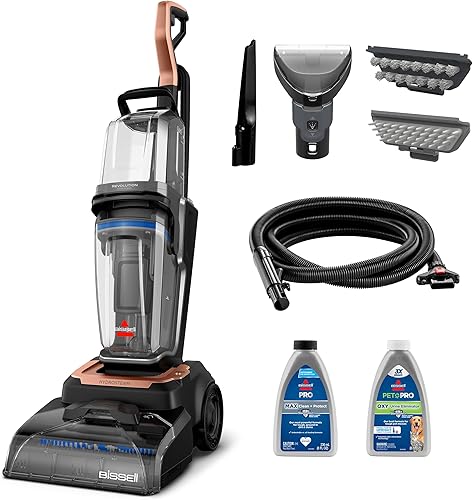
The Revolution HydroSteam suits households that need to wash carpeted rooms, with occasional hose work on compatible furniture or stairs. Its 1-gallon clean tank and XL DirtLifter PowerBrush support that floor-focused role.
Steam Pretreat loosens suitable stuck-on messes before cleaning. SteamWash Max combines steam, water and formula, so this is a carpet washer with steam features rather than a steam-only floor tool.
The 7-foot hose gives you another way to reach couches, stairs and pet beds. That helps if you want one machine for floor cleaning and smaller fabric jobs.
Skip it if most of your work is a small spill in an otherwise clean room. At 20 lb, it also needs more thought about carrying and storage than a compact portable.
Bissell Little Green HydroSteam: for varied spot jobs
The Little Green HydroSteam suits localized messes where different surfaces need different modes. Choose it for a mix of approved carpet spots, upholstery, car interiors and tile work.
SteamWash handles tough oily messes, Steam serves compatible upholstery and tile or grout, and Wash is intended for enzyme-based stains such as pet accidents. The mode choice should follow the mess and surface instructions.
Its 64 oz. clean tank and 13 lb weight sit between the upright and Mini. The included 5-inch Tough Stain Tool handles fabric work, while the Multi-Surface Tool serves approved hard-surface jobs.
Skip it if you mainly want to wash whole rooms. Also skip the extra steam options if your fabrics do not allow heat and your routine only calls for simple spot extraction.
Bissell Little Green Mini: for occasional small spills
The Little Green Mini suits a home where small messes and limited storage matter more than room coverage. It sprays, scrubs and suctions without a steam mode.
At 7 lb, it is the lightest option here. Its 16 oz. capacity and 4-inch Tough Stain Tool favor short jobs on compatible carpet, upholstery, pet beds or car interiors.
The HydroRinse tool helps rinse the hose after cleaning. You still need to empty and clean the recovery tank rather than treating hose rinsing as the whole cleanup.
Skip the Mini for broad traffic lanes or several rooms of carpet. A narrow hand tool and small capacity create more work as the cleaning area grows.
What should you check before buying?
Check surface approval, work area and cleanup needs before comparing extra features. A machine earns its storage space by fitting the jobs you repeat.
- Mostly carpeted rooms: prioritize an upright format and a tank you can carry comfortably when filled.
- Mostly furniture or car spots: prioritize tool access, carrying weight and easy tank removal.
- Mixed fabric and tile jobs: confirm that the machine has approved modes and attachments for both.
- Occasional messes: favor a machine you can store nearby and clean out quickly.
- Delicate materials: settle the permitted cleaning method before choosing any machine.
Measure the storage space, including room for the hose and tools. Think about where you will empty dirty water and leave rinsed parts to dry.
Tank capacity affects refill frequency, but it is not a room-coverage promise. Soil level, spray use and the number of passes all change how quickly you use the water.
For room cleaning, compare other formats in our full-size carpet cleaner guide. For frequent stair work, our carpet cleaners for stairs guide helps you focus on access and handling.
How should you set up and use a cleaner?
Prepare the surface first, then use the approved fill, formula and mode. Good preparation reduces the urge to keep spraying an area that needs a different approach.
Before you fill the tank
Vacuum dry carpet to remove loose dirt and hair, unless the care instructions direct otherwise. Pick up small objects and move items that block a clear cleaning path.
Check colorfastness in a hidden area as directed by the surface and formula instructions. Let that area dry before deciding whether the color or texture has changed.
Fill to the marked line using the water temperature specified in the manual. Hotter water is not an upgrade when the machine or fabric calls for a lower temperature.
Use only approved cleaning solutions at the stated amount. The guide to carpet cleaner solutions explains why household detergents and improvised mixes can cause trouble.
During washing or steaming
Work in controlled sections rather than soaking the whole area at once. With an extractor, keep the nozzle in proper contact and follow the manual’s pace for wet and suction-only passes.
Use extra extraction passes without adding more solution when the directions allow it. More spray can drive moisture deeper without removing more dirt.
With steam, keep your hands away from the nozzle and hot attachments. Follow the movement and contact-time instructions instead of holding the tool over a stubborn spot.
Stop if color transfers, the texture changes or the surface reacts poorly. Repeating the same pass is not a solution to material damage.
While the surface dries
Allow airflow and enough drying time before returning the area to normal use. Avoid putting furniture or cushions back against damp fabric.
Drying depends on the material, airflow, humidity and how much water remains. Our guide to carpet drying after cleaning helps you plan access to the room without relying on a fixed time.
How do you clean and store the machine afterward?
Empty dirty water promptly and rinse the parts that contact it according to the manual. Leaving residue inside makes the next cleanup harder and can leave the machine smelling stale.
Remove trapped hair and debris from the nozzle, brush area and tools. On the Revolution HydroSteam, the removable nozzle, brush cover and Catch & Clean Tray provide access for cleanout.
Use a hose-rinsing feature only as directed. It helps clear the hose, but it does not replace cleaning the tank, tool face or other removable dirty parts.
For a steam system, follow the water-quality and descaling guidance for that model. Never add cleaner or descaler to a steam reservoir unless the instructions permit it.
Let cleaned parts dry before reassembly or closed storage, as the manual directs. Keep cords, hoses and attachments arranged without sharp bends or strain.
Which mistakes waste the most effort?
The biggest mistakes are choosing the wrong method, adding too much liquid and expecting heat to solve every stain. Each can turn a small job into a longer cleanup.
- Treating steam as extraction: loosened grime still needs to be collected by the method the machine provides.
- Adding extra formula: excess cleaner can leave residue and create too much foam.
- Scrubbing harder: aggressive brush work can change the texture of delicate carpet or fabric.
- Cleaning only the visible center: follow stain-treatment directions for the full affected area without spreading the mess.
- Using one tool everywhere: tile approval does not make an attachment suitable for upholstery.
- Stopping at a damp surface: plan for drying as part of the job, especially before replacing cushions or furniture.
Do not judge a stain only while it is wet. Let the area dry before deciding whether it needs another treatment, and change your approach if the same mark keeps returning.
Carpet cleaner vs steam cleaner: which should you buy?
For carpet cleaner vs steam cleaner, buy around your main job: room washing calls for extraction, while steam suits approved surfaces where heat helps loosen residue. Neither choice removes the need to follow the material’s care instructions.
Pick the Revolution HydroSteam for broad carpet areas, the Little Green HydroSteam for varied spot jobs with useful steam options, or the Little Green Mini for occasional small fabric spills. Skip steam features if your surfaces cannot use them.
If room coverage and small-job convenience still compete, use our portable vs upright carpet cleaner guide to choose the format you will reach for most often.
Frequently asked questions
Is a carpet cleaner the same as a steam cleaner?
No. A carpet cleaner applies water and cleaning solution, then extracts dirty liquid; a steam cleaner applies heated vapor to suitable surfaces.
Some machines combine both methods. Choose by the cleaning process, approved materials and tools, because a steam feature does not replace the need to remove loosened soil.
Can you use a steam cleaner on carpet?
Only use steam when both the carpet care guidance and machine instructions allow it. Approval for tile does not mean approval for carpet, and a carpet attachment may serve a different purpose from washing.
Check the permitted method, settings and attachment before applying heat, especially on delicate rugs.
Does a carpet cleaner use steam?
Some carpet cleaners add steam, but many clean with water, formula, brush action and suction. The Bissell Revolution HydroSteam combines steam, water and formula in SteamWash Max mode.
The Little Green Mini uses spray, scrub and suction without a steam mode, so steam is not required for carpet washing.
Which is better for pet stains, a carpet cleaner or steam cleaner?
Choose extraction with a carpet-approved formula intended for the pet mess. Blot fresh liquid first, then follow the formula’s contact time and machine directions.
Avoid applying heat to an untreated urine stain, as it can set the stain and odor; a steam setting is not the starting point.
Can I use a portable spot cleaner instead of an upright?
Yes, if your usual jobs are isolated spills, stair spots, furniture or car interiors approved for wet cleaning. A portable tool becomes tiring across broad carpet areas because you clean a narrow strip at a time.
Choose an upright when room coverage matters more than compact storage.